



As chimeric antigen receptor (CAR) cell therapies for the treatment of solid tumors, hematologic malignancies, and autoimmune diseases continue to evolve, accurate detection and monitoring of CAR-engineered cells is critical for experimental validation. However, detection reagents for monitoring the expression of single-chain variable fragment (scFv) CARs that are based on either a target antigen or an anti-idiotype can be time-consuming to develop and optimize. Additionally, they have utility only for detecting CARs targeting a specific surface antigen or a specific scFv.
CST anti-CAR linker recombinant monoclonal antibodies are a powerful tool that can identify and confirm the presence of an engineered CAR, regardless of its antigen specificity. Because most scFv-based CARs contain either a repeating G4S or Whitlow/218 linker sequence, highly specific anti-G4S and anti-Whitlow/218 antibodies can be used to monitor the surface expression of virtually any scFv-based CAR.
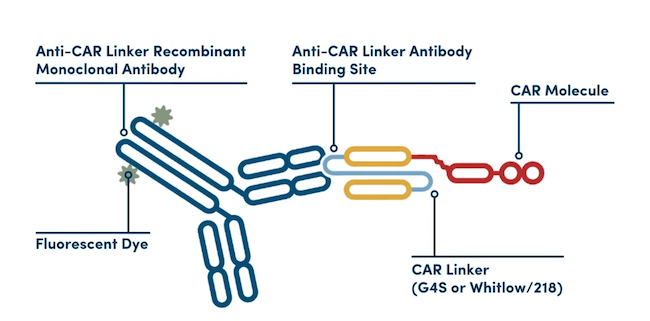 Anti-CAR linker recombinant monoclonal antibodies bind to the linker sequence (either G4S or Whitlow/218) between the variable heavy and variable light domains of scFv-based CARs.
How are scientists using the CST anti-CAR linker antibodies in their research? In this research roundup, we highlight recent publications that have utilized the CST anti-CAR linker antibodies to detect, analyze, quantitate, and purify CAR-engineered immune cells in a variety of experimental settings. To help you identify studies of interest to you, the following CAR characterization workflow framework is used to describe how CST anti-CAR linker antibodies were leveraged by the study authors:




From screening assays to monitor CAR-positive cells to labeling CAR-T cells for purification or activation, these studies provide valuable insights into the methodology and applications of linker-based antibody detection approaches.
Explore the full portfolio of CAR-engineered cell characterization solutions from CST:

Peer-Reviewed Publications Using CST CAR Linker Antibodies
Following are summaries of how the CST CAR-engineered cell characterization solution has been used in recent peer-reviewed papers as of mid-2026.
 |
Universal High-Sensitivity CAR T-cell Monitoring by Targeting Linker SequencesSchwingen et al. (Front. Immunol. 2026) | DOI: 10.3389/fimmu.2026.1787951 Researchers compared CAR detection reagents for flow cytometry, comparing their performance for CD19-, BCMA-, and Claudin-6 CAR T-cell products. They compared specificity, sensitivity, and longitudinal monitoring of lymphoma and myeloma patients. According to the researchers, “These findings establish anti-Whitlow/218 and anti-G4S mAbs as sensitive, specific, and universal reagents for CAR detection across multiple targets, constructs, and species, providing a standardized platform for harmonization of CAR T-cell monitoring in preclinical, clinical trial, and diagnostic settings.” Use Case: |
|
Development of Multivalent CAR T Cells as Dual Immunotherapy and Conditioning AgentsBubb et al. (Mol Ther Oncol.) | DOI: 10.1016/j.omton.2025.200944 Researchers from Stanford University School of Medicine developed an extracellularly linked concatemeric trivalent cytokine "ELECTRIC," single-receptor, trivalent CAR T cell therapy targeting KIT, MPL, and FLT3 for acute myeloid leukemia (AML). This therapeutic approach eliminates malignant cells and conditions the bone marrow for stem cell transplantation without requiring genotoxic chemotherapy or irradiation. This study used the G4S Linker (E702V) Rabbit mAb to detect the trivalent CAR, which used the (G4S)3 linker to combine the three cytokine receptors into a single protein. Use Case: Detect: To detect CAR cells, the G4S Linker (E7O2V) Rabbit Monoclonal Antibody clone was used for flow cytometry-based detection of the trivalent CAR, targeting three key cytokines in hematopoietic development. |
|
Chimeric Antigen Receptor T cells Against the IGHV4-34 B Cell Receptor Specifically Eliminate Neoplastic and Autoimmune B CellsCohen et al. (Science Translational Medicine 2026) | DOI: 10.1126/scitranslmed.adr9382 Researchers developed CART4-34, a targeted therapy designed to address the limitations of CD19-targeting CAR T cell therapies in treating B cell malignancies and systemic lupus erythematosus (SLE). By targeting the IGHV4-34 gene, this therapy offers high efficacy in preclinical models, reduces the risk of antigen-negative escape, and preserves healthy B cells. This paper tested short-hinge CAR T cells for cytotoxicity and anti-tumor activity. Use Case: Detect: To detect CAR cells, the PE version of the G4S Linker (E7O2V) Rabbit Monoclonal Antibody clone was used for flow cytometry-based detection of the short-hinge CAR4-34 constructs and their expression. |
Related Blogs
- CAR T Cell Detection: Anti-CAR Linker Antibodies for Whitlow/218 & G4S
- Spatial Insights for CAR-Engineered Cells in Solid Tumors: Antibody-Based CAR Detection Method
- Unlocking Protein-Level Insights in CAR-T Single Cell Analysis
Originally published March 2025. Updated June 2026.25-CAR-23050