


Single cell RNA sequencing (scRNA-seq) has been a powerful tool to uncover heterogeneity in T cell populations. However, when studying engineered T cells, RNA data alone cannot confirm which cells truly express the CAR protein. While viral transduction may deliver the transgene to T cells, it doesn’t guarantee that the CAR construct is expressed or displayed correctly on the cell surface—a critical distinction for CAR-T studies.
InTraSeq™ conjugated antibodies targeting the linker sequence of scFv-based CARs enable next-generation CAR-T research by adding direct, protein-level insights to single cell analyses. By targeting the commonly used Whitlow/218 or G4S linker domains of the scFv-based CARs, these tools enable the accurate distinction of CAR-positive engineered cells from non-transduced bystanders.
The result is more specific datasets, improved interpretation, and ultimately deeper insights into potential therapeutic response.

Direct Protein-Level Detection of CAR Molecules in Single Cell Studies
Measuring CAR protein expression directly within a single cell experiment enables researchers to ensure they are identifying bona fide CAR-expressing cells, not just cells with CAR transcripts.
For example, the Whitlow/218 linker InTraSeq conjugate was used to identify T cells transduced with a Whitlow/218 linker-containing CAR construct. In the population, not all virally transduced cells expressed the CAR protein (Figure 1), underscoring the value of direct protein detection to distinguish CAR-positive cells from non-expressing ones.
This protein-level data enables the exclusion of non-expressing cells from the dataset, resulting in improved data quality. To demonstrate the accuracy of the reagents, these results were further validated with flow cytometry (Figure 1C).
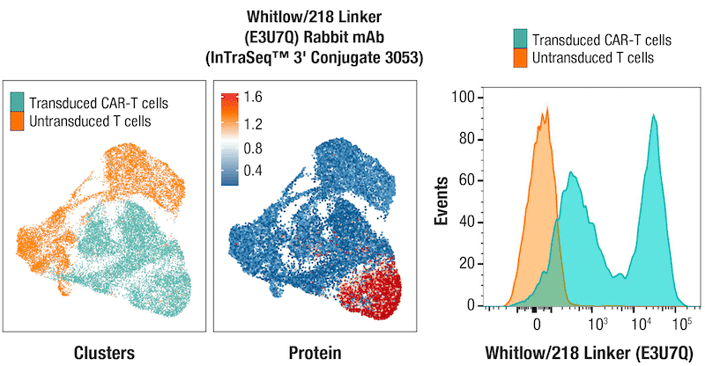 Figure 1. Untransduced T cells or T cells transduced with an scFv-based Anti-BCMA (C11D5.3) CAR containing a Whitlow/218 linker were processed in accordance with the InTraSeq™ 3’ protocol. Left: UMAP of the annotated cell clusters. Center: Whitlow/218 Linker (E3U7Q) Rabbit Monoclonal Antibody (InTraSeq™ 3' Conjugate 3053) #50265 expression. Right: Cross-validation flow cytometric analysis of untransduced T cells or T cells transduced with an scFv-based Anti-BCMA (C11D5.3) CAR containing a Whitlow/218 linker using Whitlow/218 Linker (E3U7Q) Rabbit Monoclonal Antibody (Alexa Fluor® 647 Conjugate) #69310.
Live-Cell, Pre-fixation Detection with InTraSeq CAR Linker Conjugates for Flexible Workflows
The InTraSeq CAR linker conjugates can also detect Whitlow/218 linker and G4S linker-based CARs in live cells before fixation, thereby supporting a wide range of downstream experimental workflows.
In a parallel study, the G4S linker InTraSeq conjugate was tested in a live-cell staining workflow. Jurkat cells engineered with a G4S linker-containing CAR showed clear and specific detection, while wild-type Jurkat cells, or those engineered with a Whitlow/218 linker-containing CAR, remained negative, as shown in Figure 2.
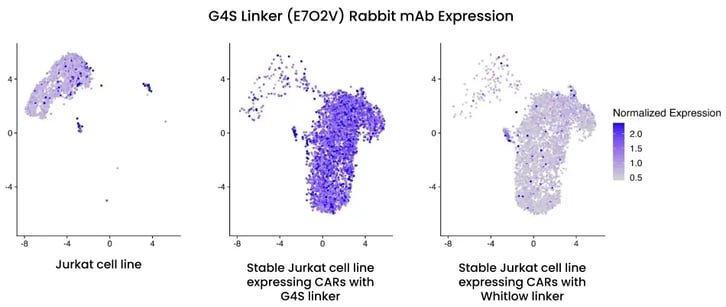 Figure 2. Jurkat cells, Jurkat cells expressing a CAR with a G4S linker, and Jurkat cells expressing a CAR with a Whitlow linker were processed according to the InTraSeq 3’ protocol. The FeaturePlots display the G4S Linker (E7O2V) Rabbit Monoclonal Antibody (InTraSeq 3' Conjugate 3118) #38470 expression in each sample.
Measuring CAR Expression in Single Cell Assays with InTraSeq Technology
Measuring CAR expression in single cell assays using InTraSeq technology offers several advantages:
- Increased Confidence in CAR Identification: Accurate detection of CAR-positive engineered cells allows for precise analysis of CAR-T populations without bias from surrounding non-transduced T cells. Additionally, it enables tracking of CAR protein expression kinetics and CAR construct stability within single cell datasets.
- Downstream Functional Assays: By combining InTraSeq CAR linker conjugates with the InTraSeq 3’ cocktails (Cocktail 1+2+3), researchers can correlate CAR expression with downstream signaling proteins in the same scRNA-seq experiment. This multiomic approach provides direct insight into downstream functional readouts such as cytokine release, signaling activation, and the cytotoxic activity of CAR-T cells.
- Assessing CAR-T Effects on Neighboring Populations: In complex cellular environments, the InTraSeq technology helps reveal how CAR-expressing cells influence neighboring cells at both the RNA and protein levels, offering a more complete view of CAR-T biology in mixed populations.
Integrated Protein and RNA Profiling for Next-Generation CAR-T Research
Both InTraSeq anti-CAR linker antibodies are compatible with the InTraSeq cocktails (Cocktail 1+2+3), supporting the simultaneous profiling of CAR expression alongside transcription factors, metabolic markers, and signaling proteins.
This capability opens the door to new biological insights—linking CAR expression and signaling states directly to transcriptional programs at the single cell level. For researchers investigating CAR-T biology, immune heterogeneity, or therapeutic mechanisms of action, InTraSeq reagents drive more comprehensive single-cell studies, helping reveal the full picture of protein and RNA biology within individual cells.
Learn more about CST solutions for single cell analysis and CAR-T research:
- Resource Center: CAR-Engineered Cell Characterization Solutions
- Product Overview: InTraSeq™ Single Cell Analysis
- Webinar: InTraSeq™ Single Cell Analysis: Get More Data from Your scRNAseq
- Interactive Pathway: CAR Signaling Networks
25-ISQ-74331