


Targeted Protein Degradation (TPD) programs are moving fast, but many still stall out at the same roadblocks: proving on‑target degradation, mapping off‑targets, and understanding the mechanism with enough insight to make confident decisions.
Liquid chromatography–mass spectrometry (LC-MS) proteomics can help you overcome these challenges by providing valuable biological insight with an unbiased, quantitative view of both protein abundance and ubiquitin modifications in a single workflow, even when antibodies don't yet exist or don't perform well for your protein of interest.

Alissa Nelson, PhD |
“The biggest challenge in TPD is not finding degraders—it’s proving what they’re really doing across the proteome. When you combine DIA proteomics with ubiquitin remnant enrichment, you’re not just measuring whether a protein gets degraded—you’re seeing the ubiquitination events that drive that change.” |
In this blog, we’ll look at how antibody‑based assays and LC‑MS–based proteomics fit together across the TPD workflow—which questions can be answered using antibody-based assays alone, when to add proteomics, how the two were combined to characterize an androgen receptor degrader, and a practical TPD proteomics workflow you can adapt in your lab.
You know your degrader. We can help reveal what it’s really doing. Talk with our proteomics scientists about starting a validation, selectivity, or MoA study with CST.
Why Mass Spectrometry‑Based Proteomics for TPD?
TPD harnesses the cell’s natural protein disposal mechanisms—including the ubiquitin-proteasome system and the autophagy–lysosome pathway—to eliminate disease‑causing proteins using small‑molecule degraders such as PROTACs and molecular glues, rather than simply blocking activity with traditional inhibitors.
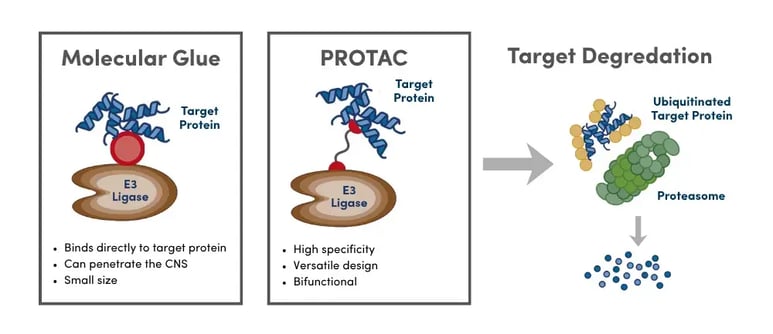
Developing TPD compounds requires extensive validation, and mass spectrometry–based proteomics can be leveraged as a vital tool to efficiently accomplish this important task, either to complement existing antibody applications or to compensate for the lack of sufficient antibody reagents. Proteomics allows for precise measurement of global protein level changes, along with ubiquitin post-translational modifications (PTMs) and other important regulatory PTMs, to assess compound activity.
“Because protein abundance and ubiquitin PTMs are measured in parellel, in the same study, you can distinguish protein‑level–only changes, PTM–level–only changes, or coordinated shifts in both—without running additional assays,” explains Alissa Nelson, PhD, Principal Scientist, Proteomics. “That’s what allows you to separate true substrates from indirect effects in a single proteomics run.”
Conversely, antibody-based techniques, including ubiquitination assays and TUBEs‑based workflows, can be powerful assays for targeted, hypothesis-driven questions about specific proteins, sites, or pathways.
In practice, most teams start with antibody-based assays to confirm target engagement and pathway effects, then add proteomics when they need a more complete understanding of on‑ and off‑target biology. For example, use mass spectrometry–based proteomics when you need to:
-
Assess degradation efficiency at scale: Quantitatively measure the reduction of target protein levels at the proteome level to confirm effective degradation and rank degrader potency.
-
Evaluate selectivity and off‑target degradation: Use global proteome profiling to detect unintended degradation of off‑target proteins, helping assess specificity and potential toxicity long before in vivo studies.
-
Determine mechanism of action (MoA): Confirm ternary complex formation and the role of the ubiquitin–proteasome system using global ubiquitin PTM proteomic profiling to identify specific lysine sites driving degradation of on‑ and off‑target proteins.
-
Identify and monitor biomarkers and pathway response: Measure protein and PTM biomarkers involved in the modulation of essential signaling pathways for predicting patient response, monitoring drug efficacy, and demonstrating that target depletion produces the expected downstream effects (reflected in PTM signaling and/or protein level changes).
So, should you use antibody assays or proteomics—or both? When leveraging a proteomics workflow, there are a few considerations to keep in mind. LC‑MS requires additional turnaround time compared to antibody-based assays, and sample preparation is much more involved.
“Proteomics won’t replace antibody‑based assays for TPD—and vice versa," Nelson adds. "The two strategies work together; antibodies help confirm the hits you expect. Proteomics finds the ones you don’t.”
Starting with antibody-based ubiquitination assays and TUBEs for rapid, targeted readouts, then strategically layering in proteomics as degraders advance and questions shift from “does it work?” to “how and where does it work?” is usually the sweet spot for teams.
Leveraging antibody-based assays? For a deeper dive into antibody-based ubiquitination assays and TUBEs workflows for TPD research, read the companion blog.
Case Study: Proteomic Characterization of an Androgen Receptor Degrader
At the 2025 TPD Keystone conference, CST Principal Scientist Alissa Nelson presented how deep proteomic profiling was used to validate the degradation of the androgen receptor (AR) in prostate cancer cells. Nelson and team applied proteomic analysis to a human prostate cancer cell line (LNCaP FGC) treated with a degrader molecule (ARCC4) and a non‑degrading antiandrogen hormone therapeutic, enzalutamide (Enza).
“By combining DIA proteomics with ubiquitin PTM enrichment, we can see both the substrates and the sites—often in a single experiment—so teams can make go/no‑go decisions with increased confidence,” says Nelson.
Leveraging mass spectrometry–based protein and PTM analysis on the Orbitrap Astral Mass Spectrometer from Thermo Scientific, the team quantified nearly 10,000 proteins and mapped site‑specific ubiquitin modifications, providing clear, unbiased data confirming on‑target efficacy, uncovering potential off‑target effects, and mapping the exact molecular sites involved in the degradation process.
The Question: Can ARCC4 Deliver Selective AR Degradation?
The team set out to compare an AR‑targeting degrader, ARCC4, with the clinically used antiandrogen enzalutamide (Enza) in a human prostate cancer cell line (LNCaP FGC). The goals were to:
-
Confirm robust, dose‑dependent degradation of androgen receptor (AR)
-
Identify additional proteins affected by ARCC4 treatment
-
Determine whether observed degradation events were linked to ubiquitination changes at specific lysine sites
The Approach: DIA Proteomics Plus Ubiquitin PTM Enrichment
Cells were treated with ARCC4 or Enza across multiple concentrations, with and without proteasome inhibition. Standard bottom‑up proteomic sample processing was conducted for both Global Proteome and Ubiquitin PTM Proteome Profiling, using an Orbital Astral analyzer operating under data‑independent acquisition (DIA) methods (Figure 1).
To complement the proteomic analysis, standard western blot (WB) analysis was performed to confirm that ARCC4 treatment induces dose‑dependent degradation of AR to levels below those observed with Enza and that the degradation is proteasome‑dependent (Figure 3). This WB step is useful for validating the on‑target activity of the degrader molecule with well‑validated antibody reagents. However, it does not provide insight into off‑target cross‑reactivity without prior knowledge and additional antibodies.
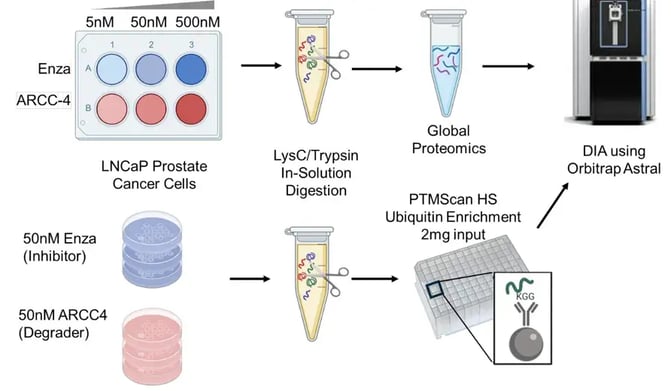
The DIA‑based proteomic workflow comprised three main steps:
-
Global proteome profiling: Deep DIA acquisition was performed on an Astral Orbitrap mass spectrometer, followed by quantification of protein abundance across all sample conditions.
-
Ubiquitin PTM enrichment and analysis: The PTMScan® HS ubiquitin remnant (K‑ε‑GG / diGly) workflow was used to isolate ubiquitinated peptides, and DIA‑based acquisition of site-specific ubiquitination data.
-
Integrated data interpretation: Overlapping protein and ubiquitin PTM measurements acquired for the majority of detected proteins, and key ubiquitination sites were mapped onto the 3D structure of AR to support structure‑based optimization.
The Results: What the Data Showed
The deep proteome coverage afforded by the Astral Orbitrap DIA analysis provided complementary protein and ubiquitin PTM measurements, with a high degree of protein coverage overlap (Figure 2). This overlap is what allows you to tell whether a degrader changes protein levels only, PTM status only, or both, directly from a single LC‑MS experiment.
Taken together, the data confirmed robust AR degradation, revealed a focused set of off‑target substrates, and linked these changes to specific ubiquitination events and structural features of AR. This combination of depth and specificity illustrates how these Proteomic applications can provide valuable insight for TPD drug development.
Depth of Coverage |
|
|
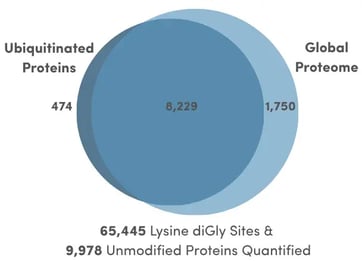
Figure 2. Deep proteome and ubiquitinome coverage for ARCC4‑ and Enza‑treated cells. |
On‑Target Degradation & Proteasome Dependency |
|
|
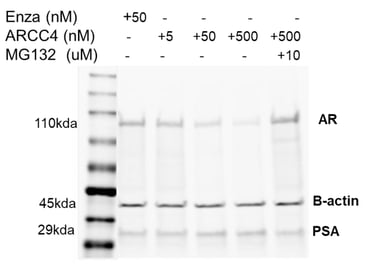
Figure 3. Dose selection and confirmation of activity using WB. Antibodies: AR #5153, PSA/KLK3 #5365, β‑Actin #4967. |
Off‑Target Degradation & Substrate Selectivity |
|
|
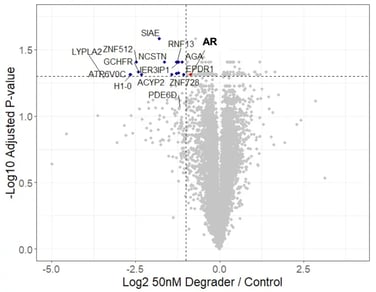
Figure 4. Global proteome profiling highlighting multiple proteins degraded by ARCC4. |
Ubiquitination Changes at the Site Level |
|
|
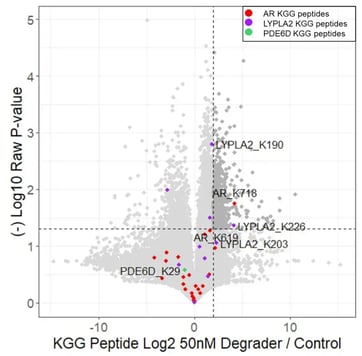
Figure 5. PTMScan profiling to characterize proteome‑wide ARCC4‑induced ubiquitination changes. |
Dose-Dependent On- and Off‑Target Degradation |
|
|
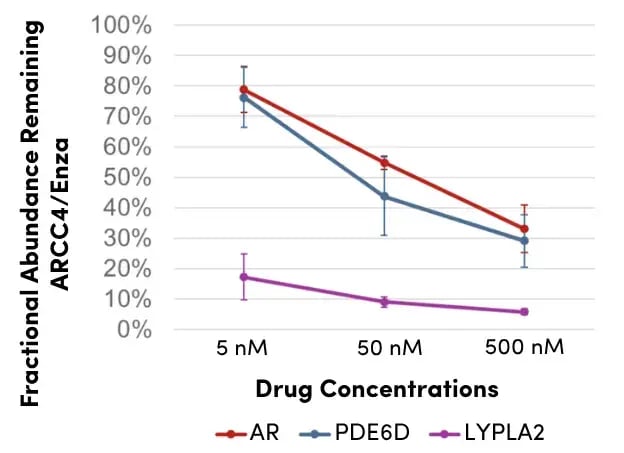
Figure 6. Identification of on‑target and off‑target substrates to ARCC4. |
Structural Mapping for Degrader Optimization |
|
|
|
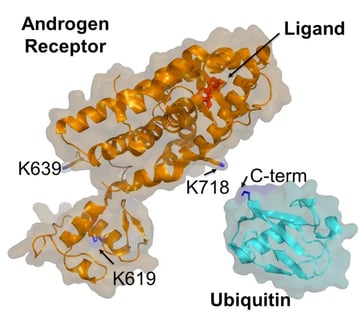 Figure 7. Mapping ARCC4‑induced differentially regulated ubiquitination sites to androgen receptor.1-4 Ubiquitin structure shown for scale.
Together, these results illustrate how DIA proteomics and ubiquitin PTM profiling can validate on‑target activity, expose off‑target liabilities, and provide mechanistic detail to guide degrader design, beyond what is practical with westerns and single‑analyte assays alone.
Want the full story? Get the AACR 2025 research poster, Optimized Ubiquitin Remnant DIA Proteomics Enables High-Throughput Screening of PROTACs, to explore the complete workflow, figures, and data.
A Practical TPD Proteomics Workflow
A typical TPD‑focused proteomics study might follow a simple four‑step workflow:
Step 1: Design and treat your model system
-
Select a relevant cell line or model system
-
Include a dose range and time course where possible
Step 2: Prepare and enrich your samples
-
Perform bottom‑up proteomic sample prep
-
Split material for:
-
Global proteome profiling
-
Ubiquitin remnant enrichment (PTMScan HS K‑ε‑GG)
-
Optional additional PTMs (e.g., phospho-Tyr, phospho-Ser/Thr) to document cellular signaling in response to effective (or ineffective) degrader treatment
-
Step 3: Acquire DIA data on a high-resolution platform
-
Run DIA acquisition on an instrument such as the Orbitrap Astral analyzer to maximize depth and quantitative reproducibility
-
Apply consistent acquisition parameters across conditions to enable robust comparisons
Step 4: Integrate protein, PTM, and structural data
-
Quantify changes in protein abundance and site-specific ubiquitination across conditions
-
Identify on‑target and off‑target substrates, confirm UPS involvement, and connect changes to pathway readouts
-
Map critical sites to protein structures (experimental or AlphaFold) to support structure‑guided degrader optimization
CST’s proteomics services team can help you adapt this framework to complement the antibody-based TPD assays and ubiquitination workflows described elsewhere in this blog series.
Beyond AR: How CST Proteomics Supports TPD Programs
CST combines proprietary PTMScan enrichment kits, long‑standing expertise in ubiquitin and signaling biology, and a track record across multiple TPD programs to deliver a high level of ubiquitinome and pathway insight. The CST proteomics services team has supported multiple TPD projects, including:
-
Pan‑TEAD Degradation in the Hippo Pathway: T. H. Pham and colleagues (Genentech) used CIDEs to promote potent pan‑TEAD degradation. Ubiquitin remnant profiling confirmed TEAD ubiquitination, proteasome‑directed degradation, and downstream Hippo pathway suppression, supporting pan‑TEAD degradation as a viable therapeutic strategy.3
-
Degradation of Tau & Other Targets using AdPROM and PROTACs: G. Sathe and collaborators (University of Dundee) combined global proteomics with diGly PTMScan enrichment and DIA MS to establish MoA for multiple TPD modalities, demonstrating robust Tau degradation and extensive mapping of ubiquitylation sites to prioritize degrader designs with strong on‑target engagement and clean selectivity profiles.4
-
FAK Degrader vs FAK Inhibitor: Linking degradation to Signaling: Koide and collaborators integrated global proteome, ubiquitinome, and phospho‑profiling to show loss of FAK signaling upon degradation, guiding development of both a selective FAK inhibitor and FAK degrader and improving kinome‑wide selectivity of a FAK‑directed PROTAC.5
Our Proteomics Services team has over 25 years of experience and can provide customized experimental design, sample preparation, data acquisition, and analysis tailored to your goals. We’ll work with you to ensure the results are biologically meaningful and actionable for your TPD program.
With advanced DIA workflows, PTMScan enrichment platforms, and deep expertise in ubiquitin and signaling biology, CST can help you:
-
Design studies that integrate antibody-based assays with global proteomics to validate degrader activity from multiple angles
-
Quantify on‑ and off‑target degradation and confirm ubiquitin‑proteasome dependency
-
Map site-specific ubiquitination, phosphorylation, and other PTMs to link degradation to functional pathway changes
-
Support MoA, safety, and biomarker strategies from discovery through translational research
“TPD teams know their targets and degraders better than anyone,” says Nelson. “Our job is to bring the proteomics depth that shows exactly what those molecules are doing across the proteome—so you can move forward with confidence.”
Reach out to co‑design a proteomics strategy for your degraders and learn how CST Proteomics Analytical Services can help advance your targeted protein degradation research. Submit an inquiry here.
Select References
- Jumper J, Evans R, Pritzel A, et al. Highly accurate protein structure prediction with AlphaFold. Nature. 2021;596(7873):583-589. doi:10.1038/s41586-021-03819-2
- Varadi M, Anyango S, Deshpande M, et al. AlphaFold Protein Structure Database: massively expanding the structural coverage of protein-sequence space with high-accuracy models. Nucleic Acids Res. 2022;50(D1):D439-D444. doi:10.1093/nar/gkab1061
- Schrödinger, LLC. The PyMOL Molecular Graphics System. Version 3.0. Schrödinger, LLC; 2020.
- Matias PM, Donner P, Coelho R, et al. Structural evidence for ligand specificity in the binding domain of the human androgen receptor. Implications for pathogenic gene mutations. J Biol Chem. 2000;275(34):26164-26171. doi:10.1074/jbc.M004571200
- Pham TH, Pahuja KB, Hagenbeek TJ, et al. Targeting the Hippo pathway in cancers via ubiquitination‑dependent TEAD degradation. eLife. 2024;13:e92450. doi:10.7554/eLife.92450
- Sathe G, Röth S, Gelders G, et al. Data‑independent acquisition (DIA) approach for comprehensive ubiquitinome profiling in targeted protein degradation. bioRxiv. Preprint posted May 27, 2025. doi:10.1101/2025.05.27.656291
- Koide E, Mohardt ML, Doctor ZM, et al. Development and Characterization of Selective FAK Inhibitors and PROTACs with In Vivo Activity. Chembiochem. 2023;24(19):e202300141. doi:10.1002/cbic.202300141
- Salami J, Alabi S, Willard RR, et al. Androgen receptor degradation by the proteolysis-targeting chimera ARCC-4 outperforms enzalutamide in cellular models of prostate cancer drug resistance. Commun Biol. 2018;1:100. Published 2018 Aug 2. doi:10.1038/s42003-018-0105-8