


If you work in drug discovery, you’re likely under constant pressure to deliver high‑quality data at scale—and on timelines that leave little room for error. High‑throughput screening, hit-to-lead, and lead optimization all demand assays that are sensitive, robust, and compatible with automation in 384‑ or 1536‑well plates.
Time‑Resolved Fluorescence (TRF) Förster Resonance Energy Transfer (TR‑FRET) assays have become a go‑to solution because they deliver high sensitivity and minimum background noise, along with no-wash, mix‑and‑read convenience, rapid time-to-results (~1-2 hours), and low-volume inputs (~20 µL in a 384-well format). Combined with a wide dynamic range and reliable performance in automation‑friendly, high‑throughput screens, TR‑FRET is a powerful way to scale assays without sacrificing data quality.
 Steven Mullenbrock, PhD Steven Mullenbrock, PhDPrincipal Scientist, Molecular Assays Group |
"Once you establish a reliable TR-FRET assay, running it at the bench is surprisingly easy. But the secret to success is having a flexible toolbox of high-quality antibody pairs and conjugates to serve as a strong foundation for assay development." |
Here, we cover what TR‑FRET is, the principles of how it works, and why europium (Eu)-based TR‑FRET assays are well‑suited for high‑throughput, automated drug discovery assays.
What’s TR‑FRET About? Basics and Principles
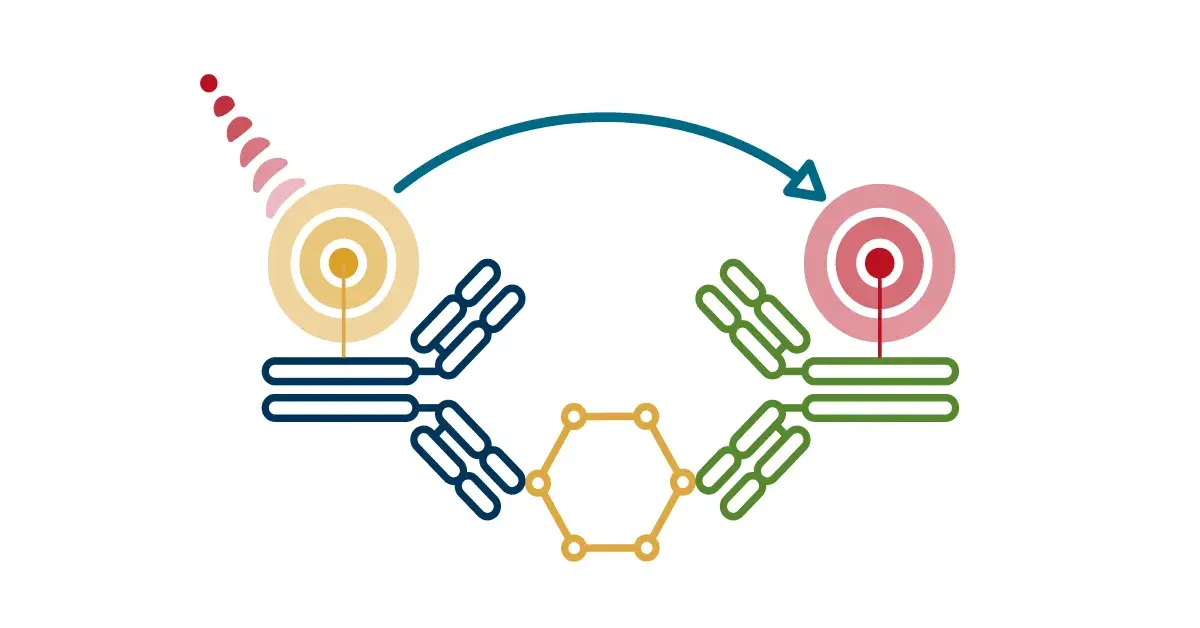
TR-FRET takes advantage of long-lived fluorophores (for time-resolved measurements) and combines them with the principle of FRET. FRET is an energy transfer process in which an excited donor fluorophore transfers energy to an acceptor fluorophore when they are close together (10-100 Å), as illustrated in Figure 1. That close proximity requirement allows FRET to detect changes in protein levels, protein-protein interactions, and drug-protein interactions, whether that’s two epitopes on the same protein, a receptor–ligand pair, or a target–E3 ligase complex in targeted protein degradation (TPD).
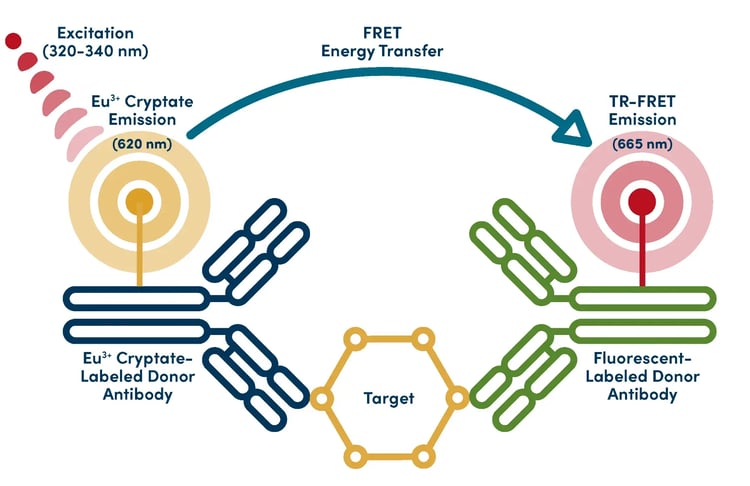 Figure 1. Diagram of excitation and emission in a europium-red-acceptor-based TR-FRET assay. When an interaction takes place and FRET occurs, the donor emits at ~620 nm and the acceptor emits at ~665 nm. When no interaction occurs, only the donor emits at ~620 nm.
Where TR‑FRET differs from conventional FRET is in the type of donor used and the way the signal is measured:
- The donor is a long‑lived fluorophore, commonly a lanthanide such as europium (Eu or Eu3+) or terbium (Tb), rather than a conventional organic dye.
- Because lanthanide donors emit fluorescence that persists for milliseconds, TR-FRET-compatible plate readers can introduce a short time delay (microseconds range) after excitation, so that only long‑lived signals are measured.
Compared with short‑lived fluorophores, which are more prone to interference from sample autofluorescence and direct excitation of the acceptor by incidental light, time‑gated detection selectively captures the long‑lived lanthanide and FRET‑mediated acceptor emission.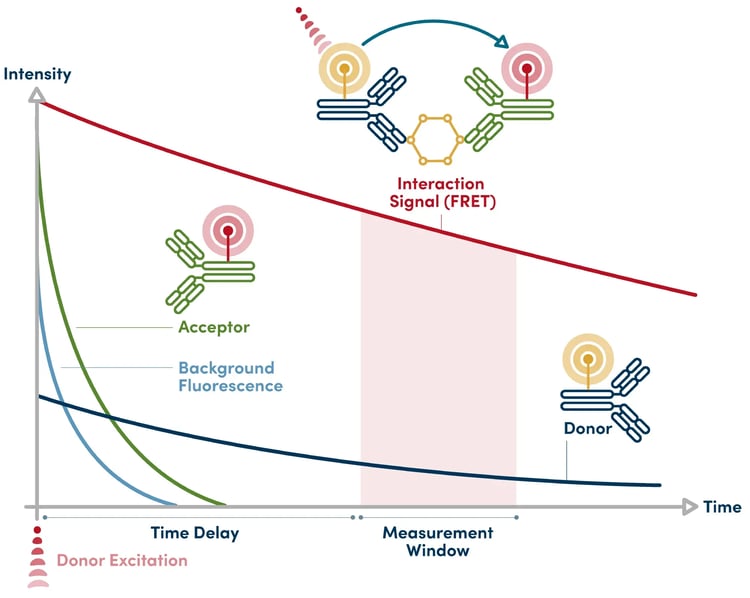
Figure 2. Time-gated TR-FRET detection. The excitation pulse is followed by a time delay during which background fluorescence decays. The long-lived donor and acceptor emissions from the TR-FRET interaction are measured within a selected time window to improve signal‑to‑background.
Lanthanide ions like Eu³⁺ and Tb³⁺ also exhibit a large Stoke’s shift—the difference between the peak excitation and emission wavelengths—allowing cleaner separation between donor and acceptor signals in the plate reader. Together, the large Stoke’s shift and time‑gated detection dramatically improve signal‑to‑background and enable robust measurements in complex biological samples using a fully homogeneous, no‑wash workflow.
"Once you establish a reliable TR-FRET assay, running it at the bench is surprisingly quick and easy," explains Steven Mullenbrock, PhD, Principal Scientist in the Molecular Assays Group at CST. "But the secret to this success is having a flexible toolbox of high-quality matched antibody pairs and conjugates to serve as a strong foundation for TR-FRET assay development."
Donors: Why Europium and Other Lanthanides Make TR‑FRET Powerful
Donor molecules in TR-FRET are typically antibodies, peptides, or proteins conjugated to a lanthanide. While lanthanide atoms on their own have long decay rates following excitation, they lack the ability to efficiently collect and transfer the energy to the acceptor fluorophore. For this reason, the lanthanides are embedded in a light-collecting cage, commonly formed by creating a cryptate or chelate, that acts as an antenna and improves excitation and emission efficiency.
Cryptate conjugates are known to be more stable than chelates across a wide range of pH and assay conditions and resist metal dissociation, which helps maintain performance in demanding screening environments.1-4
"This stability is why our TR-FRET toolbox focuses on Eu³⁺ cryptate‑based donors—we have many Eu³⁺ cryptate–conjugated antibodies available off-the-shelf that we've tested for TR‑FRET assays," says Mullenbrock. "If your experiment calls for something different, we can also generate Eu3+ chelate conjugates or additional Eu³⁺ cryptate conjugates from our extensive antibody portfolio."
Eu³⁺ cryptate conjugates are excited by the lamp or laser at 320-340 nm and have a relatively sharp emission spectrum around 615-620 nm, which works well with common red‑shifted acceptor dyes, as shown in Figure 3.
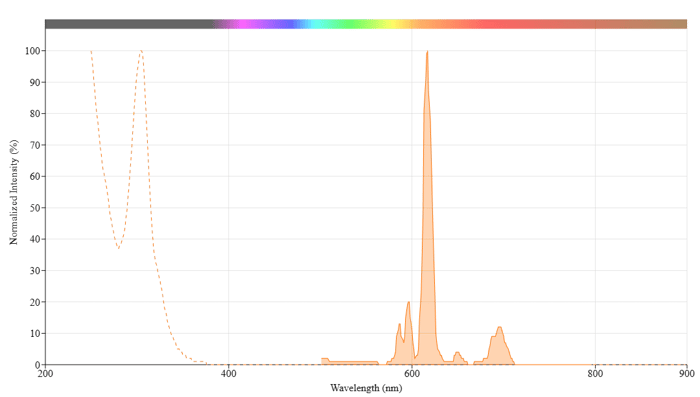 Figure 3. Fluorescence Spectral Viewer image of trFluorTM europium cryptate excitation (dotted line) and emission (solid line) spectrum.
|
Europium Conjugates Explore our off-the-shelf europium cryptate conjugates, all of which have been tested for use in TR-FRET. Need a Eu3+ antibody conjugate that’s not listed, or a chelate conjugate? Reach out to us about custom conjugations. |
Acceptors: Choosing the Right Red‑Shifted Partner
The fluorescent acceptor molecule is typically a traditional fluorophore that is chosen based on the spectral overlap between the donor emission and the acceptor excitation, conjugated to another antibody, peptide, or protein. When the donor and acceptor are in proximity, the emission energy of the donor excites the acceptor, causing the fluorophore to emit a signal at a higher wavelength.
When using Eu³⁺ conjugated donors, the acceptor dye should have an excitation band near the Eu³⁺ emission peak (~620 nm) and an emission that is sufficiently red‑shifted to be clearly separated from donor emission. In practice, “red dyes” such as Alexa Fluor® 647 or allophycocyanin (APC) are often used as acceptors in Eu³⁺‑based TR‑FRET assays.
|
AlexaFlour® 647 & APC Conjugates Explore our antibody conjugates to Alexa Fluor® 647 and Allophycocyanin (APC), which can be paired with Eu³⁺ conjugates for use in assay development and screening. These dyes can also be custom-conjugated to the antibody of your choice using our custom conjugation services. |
In Summary: How a TR‑FRET Assay Works
Regardless of the specific assay type, the principle of TR-FRET is the same: a Eu³⁺ cryptate conjugated donor is mixed with a fluorophore-conjugated acceptor. Upon excitation of the donor, energy is transferred to the acceptor when they are in close proximity. A TR-FRET-compatible plate reader is needed to excite Eu³⁺ cryptate and measure donor and acceptor emission simultaneously after a delay. A ratiometric signal (acceptor/donor) is then reported, which normalizes for well‑to‑well variation or small volume differences.
Because everything happens in solution, TR‑FRET assays are truly homogeneous: you mix reagents and sample, incubate, and read, without adding wash steps to remove unbound components. That homogeneous nature is a major reason TR‑FRET is so well‑suited for high‑throughput, automation‑friendly workflows.
Select References
-
Degorce F, Card A, Soh S, Trinquet E, Knapik GP, Xie B. HTRF: A technology tailored for drug discovery - a review of theoretical aspects and recent applications. Curr Chem Genomics. 2009;3:22-32. Published 2009 May 28. doi:10.2174/1875397300903010022
-
Mathis G. Rare earth cryptates and homogeneous fluoroimmunoassays with human sera. Clin Chem. 1993;39(9):1953-1959.
-
Maurel D, Comps-Agrar L, Brock C, et al. Cell-surface protein-protein interaction analysis with time-resolved FRET and snap-tag technologies: application to GPCR oligomerization. Nat Methods. 2008;5(6):561-567. doi:10.1038/nmeth.1213
-
Nørskov-Lauritsen L, Thomsen AR, Bräuner-Osborne H. G protein-coupled receptor signaling analysis using homogenous time-resolved Förster resonance energy transfer (HTRF®) technology. Int J Mol Sci. 2014;15(2):2554-2572. Published 2014 Feb 13. doi:10.3390/ijms15022554