


If you’ve run enough western blots, you’ve probably had this experience: you optimize exposure to get one band in range, only to blow out another. Eventually, you end up stripping and re-probing anyway. At some point, it starts to feel less like quantification and more like never-ending troubleshooting.
Fluorescent western blotting offers a more controlled approach to protein detection, helping overcome the dynamic range limitations of traditional chemiluminescence. By enabling simultaneous detection of multiple targets on a single membrane, it supports more accurate, quantitative comparisons across proteins and conditions. Its broader linear range and stable signal also reduce dependence on exposure timing, making it easier to capture both low- and high-abundance targets in the same experiment.
But multiplexing introduces its own set of challenges—signal balance, antibody compatibility, and experimental design all become more critical. In this post, we share practical tips to help you design robust multiplex fluorescent western blots that deliver data with true quantitative integrity.
Browse CST antibodies validated for Fluorescent Western.
Why consider fluorescence over chemiluminescence?
Enhanced chemiluminescence (ECL) has long been the default format for western blotting and remains a reliable choice for many routine, single-target blots. For more complex experiments, however, when you need multiplex detection or wide dynamic range quantification, the tradeoffs of ECL become more apparent.
Because ECL relies on an enzymatic reaction—typically horseradish peroxidase (HRP) acting on a substrate—the process is limited by enzyme kinetics and substrate exhaustion. As a result, the signal is transient and highly sensitive to timing and exposure conditions. The usable linear range can be relatively narrow, and saturation can happen quickly.
|
|
“The broad linear range and signal stability of fluorescent western blotting provide a level of quantitative reliability that can’t be achieved with the traditional chemiluminescence format, particularly across a wide dynamic range.” |

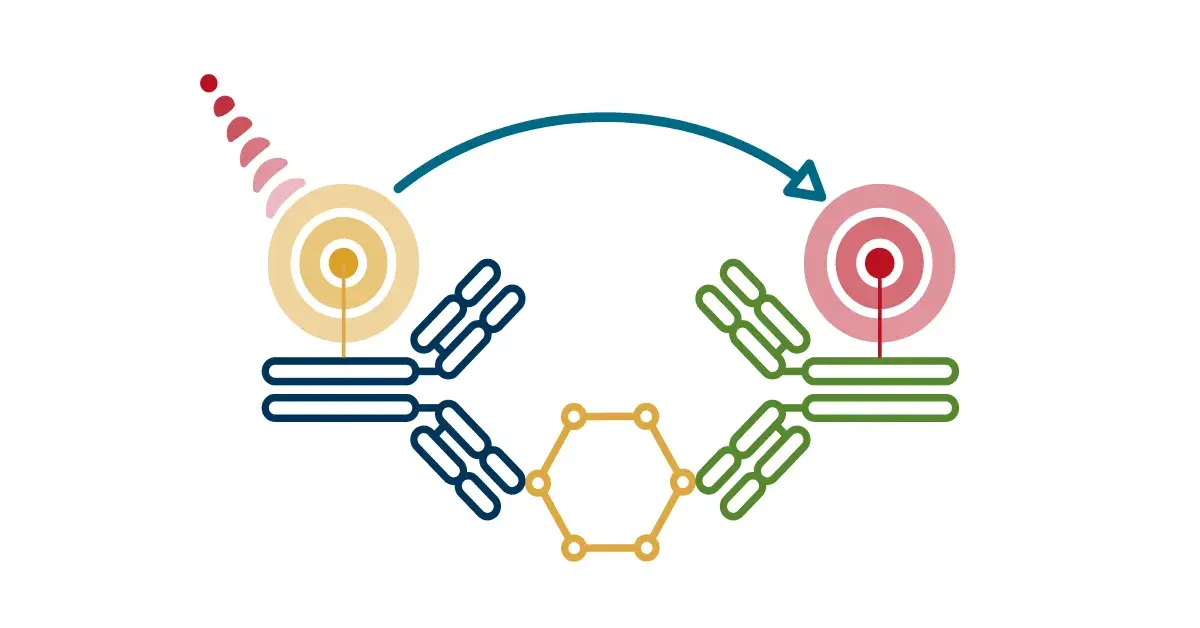
Fluorescent western blotting works differently. Secondary antibodies are directly conjugated to fluorophores, so signal intensity is more directly proportional to the amount of protein present on the membrane, rather than dependent on enzyme kinetics.
This difference provides several key advantages:
-
Multiplexing Capabilities: Detect multiple proteins (e.g., a phospho-protein and its total protein counterpart) on the same blot simultaneously.
-
Signal Stability: Fluorescent signals are stable over time, allowing for re-scanning weeks later and long-term data preservation.
-
Reduced Stripping & Reprobing: Multiplex detection minimizes reliance on stripping, reducing the risk of protein loss and inconsistent data associated with harsh stripping buffers.
-
Data Integrity in Quantification: A broad linear dynamic range enables relative quantitative measurements and higher data integrity for both high- and low-abundance proteins simultaneously.
The Quantitative Advantage: Integrity Beyond the Display
Many users generate excellent qualitative and semi-quantitative data with ECL. However, one of the most powerful advantages of fluorescent WB—and one that is often overlooked—is how fluorescent imaging separates data acquisition from visualization. The separation results in the absolute integrity of the raw data.
In traditional ECL, the "exposure" and the "data" are tied together; if you expose a film for a few seconds longer, the bands get darker, the background changes, and you risk saturating your signal. You are essentially "creating" the image and the data at the same time.
Fluorescent WB breaks this link by separating the data from the display:
-
The Raw Data (Locked): When the scanner captures your blot, it assigns a permanent mathematical value to every pixel based on the photons emitted. This captures the true physical relationship between the signal in your band and the background of the membrane.
- The Display (Visual Flexibility): Because the raw data is locked, you can adjust the brightness, contrast, or "lookup tables" on your screen to make a band easier to see for a presentation without ever altering the underlying numbers.
Whether you make the band look faint or incredibly bright on your monitor, the software’s quantification (the signal intensity value) remains unchanged. This eliminates the user bias common in ECL and ensures your results are mathematically robust and reproducible, regardless of how you choose to visualize them.
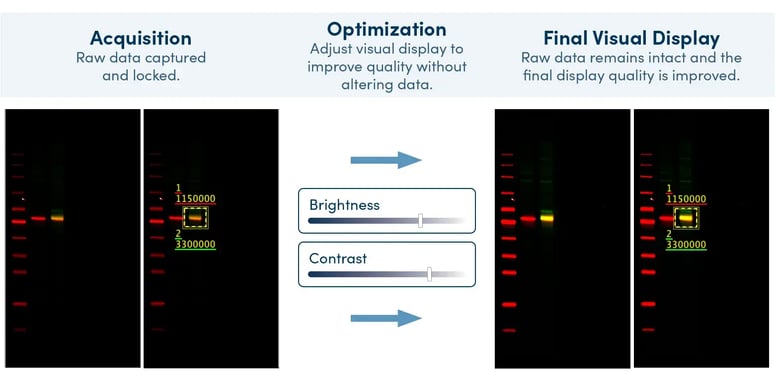 Figure 1. Fluorescent western blot image workflow showing locked raw data acquisition with adjustable brightness and contrast, which enables visual optimization and a clear final display without changing the underlying quantitative signal values.
Multiplex Readouts for Signaling Pathways
In neuroscience and cancer research, understanding the ratio of a phosphorylated protein to its total protein level is critical for assessing pathway activation. By using fluorescent multiplexing, you can use two different primary antibodies—for example, a Rabbit Phospho-Akt and a Mouse Total Akt—and detect them with species-specific secondary antibodies (680 nm and 800 nm). The resulting composite image provides a precise ratio of activation within every single sample lane.
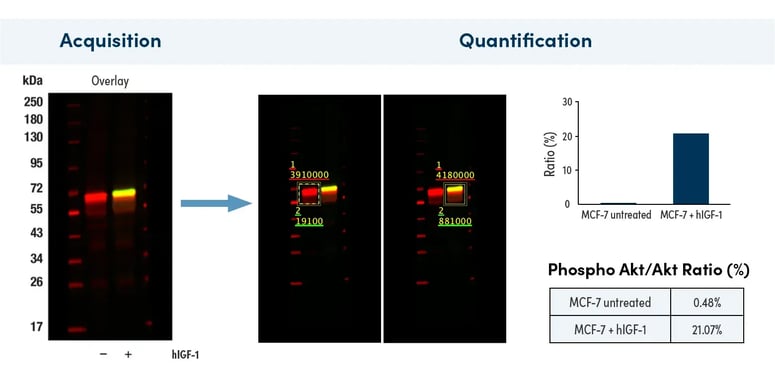 Figure 2. Fluorescent western blot analysis of extracts from MCF-7 cells, untreated (-) or treated with hIGF-1 (100 ng/ml, 10 min; +), using Akt (pan) (E7J2C) Mouse Monoclonal Antibody #58295 (red) and Phospho-Akt (Ser473) (D9E) Rabbit Monoclonal Antibody #4060 (green). Anti-mouse IgG (H+L) (DyLight® 680 Conjugate) #5470 (red) and Anti-rabbit IgG (H+L) (DyLight® 800 4X PEG Conjugate) #5151 (green) were used as secondary antibodies.
Beyond phospho-specific signaling, multiplexing allows you to quantify functionally related proteins simultaneously. For example, you can detect a transcription factor and its downstream target gene product on the same blot. This provides a direct, sample-specific correlation between the presence of a regulator and its functional output, eliminating the lane-to-lane or blot-to-blot variability that often plagues sequential ECL experiments.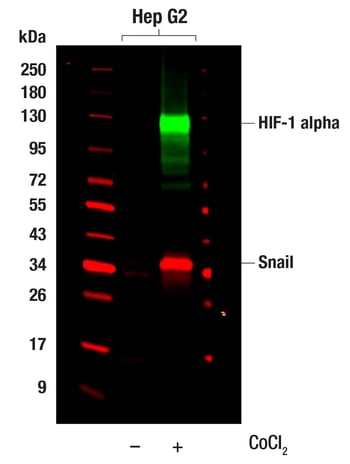 Figure 3. Fluorescent western blot analysis of extracts from Hep G2 cells, untreated (-) or treated with CoCl2 (100 μM, 24 hr; +), using Snail (L70G2) Mouse Monoclonal Antibody #3895 (red) and HIF-1 alpha (D1S7W) Rabbit Monoclonal Antibody #36169 (green). Anti-mouse IgG (H+L) (DyLight® 680 Conjugate) #5470 (red) and Anti-rabbit IgG (H+L) (DyLight® 800 4X PEG Conjugate) #5151 (green) were used as secondary antibodies.
Best Practices for Designing a Successful Multiplex Fluorescent Western Blot
1. Sample Preparation: Less is Often More
In traditional ECL, the reflex is often to load more protein to ensure a strong signal. In fluorescent WB, this can be counterproductive. We recommend loading between 10–20 µg of protein sample. Increasing the load beyond this can actually reduce the detected signal due to quenching or steric hindrance. Unlike traditional WB, you may find that decreasing your sample load improves the clarity of your data.
2. Prioritize Nitrocellulose Over PVDF
While researchers often use low-fluorescence PVDF, it frequently requires expensive commercial blocking buffers to achieve a clean scan. At CST, we have optimized our protocols to use standard BSA or milk solutions, significantly reducing the cost of each experiment. Because these cost-effective blocking agents can lead to high background on PVDF, we strongly recommend using nitrocellulose membranes. This combination ensures a clean, quiet background without the need for specialized, high-cost buffers.
3. Strategic Multiplexing: Sensitivity and Channels
Use the 800 nm channel strategically. Generally, 800 nm conjugated secondary antibodies are more sensitive than 680 nm secondary antibodies. Reserve the 800 channel for your least abundant targets or proteins with low expression. If you are only detecting a single protein, always use an 800 nm secondary for maximum sensitivity.
4. Prevent Interference from Molecular Weight Markers
Molecular weight markers often contain blue dyes that fluoresce strongly in the 680 nm channel. This can mask your target signal if they overlap. To mitigate this, titrate your marker (use much less than you would for ECL) and avoid using the 680 nm channel for weak targets near marker bands.
5. Tips for Scanning and Maximizing Signal
-
The "Game-Changer" Drying Step: For low-expression proteins, drying the membrane before scanning can increase signal detection by approximately two-fold.
- Avoid "Batch" Scanning: Scan membranes individually. If you scan a very bright blot next to a weak one, the scanner will auto-adjust its sensitivity to the bright one, making your weak blot disappear.
- One Species, One Target: Avoid co-incubating multiple primaries from the same species. A strong signal from one protein can interfere with the detection of a weaker signal on the same channel.
Designing Better Multiplex Fluorescent Western Blots
Fluorescent western blotting delivers a level of precision and multiplexing capability that chemiluminescence cannot match. By leveraging the quantitative integrity of digital imaging and utilizing CST’s cost-optimized nitrocellulose protocols, you can ensure your data is both high-fidelity and reproducible.
For more routine, single-target blots, ECL can be a practical and familiar option. However, if you need multiplex detection or greater data integrity for relative comparisons, fluorescence is the better choice. Success simply requires a disciplined approach to experimental design and signal management.
Browse CST antibodies validated for Fluorescent Western.
DyLight is a registered trademark of Thermo Fisher Scientific, Inc. and its subsidiaries.