



Since the invention of the enzyme‑linked immunosorbent assay (ELISA) more than 50 years ago, the original format has spawned a wide range of ELISA‑like immunoassays that use new enzyme conjugates, detection chemistries, and instrument platforms for colorimetric, chemiluminescent, and fluorescent readouts. While these formats have simplified workflows and expanded use across many sample types and instruments, the assay’s foundation remains unchanged: The quality and compatibility of the capture and detection antibodies—each of which binds to a different epitope on the same target—are ultimately what determine assay specificity, sensitivity, and reproducibility.
In today’s high-throughput, multi-site programs, a single weak antibody can derail months of screening, inflate false positives, and delay critical go/no-go decisions. This makes antibody performance a program‑level risk factor, not just a technical detail. But what determines a high-quality matched antibody pair, and how can assay development teams ensure reliable performance over the lifespan of a project?
When building an antibody pair‑based assay, focusing on a few core principles—antibody specificity, pair compatibility, and early testing of conjugated forms—can help you develop a high‑throughput assay that performs reliably from initial feasibility through transfer to screening and scale‑up.
Antibody Specificity Reduces Background Noise and Improves Data
Antibody specificity—the ability of an antibody to recognize its intended epitope while avoiding off‑target binding—not only ensures you’re measuring your protein of interest, it also drives sensitivity by affecting background signal/noise. High specificity reduces nonspecific binding, lowering baseline signal and enhancing sensitivity. In a high-throughput screening or biomarker program context, this translates directly into lower false‑positive rates, fewer plate repeats, cleaner QCs, and less time spent troubleshooting irreproducible data.
When an antibody is bound to a surface, its baseline pre-binding signal is typically low; but when the sample (such as plasma or cell lysate) is added, it contains thousands of other proteins that could nonspecifically bind to the antibody. The more nonspecific binding that occurs, the higher the background noise. While statistical or experimental approaches can help lower the baseline, no amount of curve‑fitting can fully compensate—achieving a sensitive, reliable assay is ultimately dependent on the specificity of the antibodies used.
“When building your own sandwich immunoassay, your chances of success are much higher if you start with antibodies that have been shown to work in an antibody pair,” says Mark Stump, Associate Director of ELISA & Assay Development at CST. “We rigorously validate our matched antibody pairs and control our own manufacturing, which supports specificity, sensitivity, reproducibility, and reliable supply. From there, providing these antibody pairs and our individual ELISA-validated antibodies in carrier‑free, conjugation‑ready formats is what makes them compatible with a variety of platforms.”

The importance of reliability cannot be overstated—in the United States, an estimated $28 billion is spent annually on preclinical research that is not reproducible, with approximately $350 million attributed to subpar antibodies.1 For high-throughput screening and drug development projects, starting with application-validated monoclonal antibodies specifically validated in the assays and tissues for which they will be used can reduce troubleshooting cycles and the risk of late-stage failure. This is especially important when assays must be transferred between internal groups or external partners and still meet predefined performance criteria.
Compounded Specificity and Sensitivity with Antibody Pairs
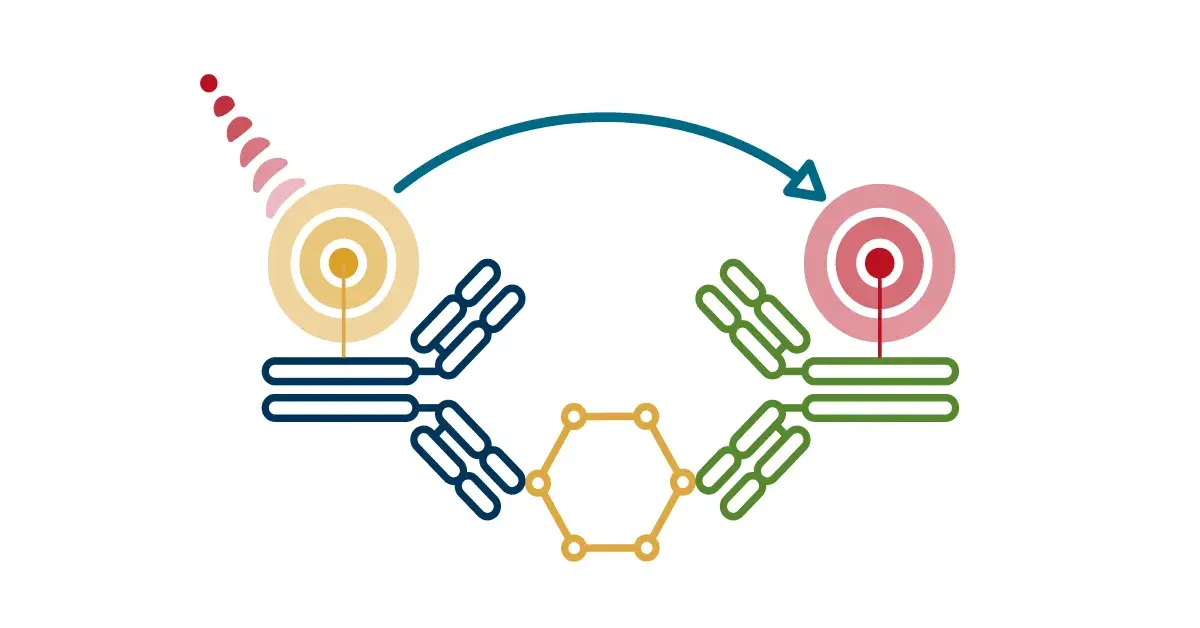
In pair-based immunoassays, combining two antibodies in a sandwich format compounds specificity: One antibody captures the target, and the other detects it.
But doesn’t using two antibodies increase the risk of background noise? While this is a valid concern, the combined specificity of a well‑characterized, matched antibody pair almost always outweighs that risk. In a typical sandwich ELISA assay, the capture antibody immobilizes the antigen on the plate surface, and the detection antibody—often enzyme‑linked—binds a distinct epitope to generate signal. Because both antibodies must bind the same analyte to produce a readout, off‑target interactions are very unlikely.
This dual recognition is a key reason sandwich immunoassays are widely regarded as among the most specific and sensitive formats for measuring low-abundance proteins in complex samples such as serum, plasma, or cell lysates, and why they underpin many ultra‑sensitive platforms such as Meso Scale Discovery (MSD), AlphaLISA/ AlphaScreen, Luminex xMAP, TR‑FRET/HTRF, Quanterix Simoa, or Bio‑Techne Ella.
Building High-Quality Sandwich Immunoassays
While immunoassays using two paired antibodies offer increased specificity, sensitivity, and accuracy compared to single antibody assays, they also come with more assay development challenges:
- Finding the ideal antibody pair is resource-intensive. Identifying two antibodies that recognize non-overlapping epitopes and work together in both unconjugated and conjugated formats takes time and testing.
- Ensuring binding site accessibility is crucial. It’s essential to confirm that no compound binding site interference exists between the tested compound and either antibody—both the capture and detection antibodies must be able to interact with and bind to their target for optimal assay performance.
- Assay optimization and antibody pair validation take time and expertise. The time spent searching for optimal pairs, conducting testing, and optimizing assay performance is time-consuming and can delay the ultimate goal of delivering reliable and reproducible results while also meeting project deadlines.
So, how do you develop a good high-throughput immunoassay that works regardless of the platform?

Practical Considerations for Designing Successful Pair-Based Immunoassays
The bottom line is that your sandwich immunoassay is only as trustworthy as your antibodies are specific and sensitive. Early antibody pair validation—especially in conjugated forms—can prevent problems during scale-up or transitions to new detection methods, safeguarding assay integrity even when conjugation chemistries or formats are changed.
Here are a few practical considerations for successful antibody pair-based assay development:
-
Select for format-specific validation. Start with specific monoclonal antibodies that have been validated for pair-based immunoassays—especially manufacturer-validated matched antibody pairs. When these are unavailable, select antibodies against your target of interest that have been validated across multiple applications to broaden compatibility.
-
Check species reactivity. Confirm the antibodies will recognize the target protein in your sample type, especially if the assay will be applied to multiple species, sample types, or new indications over the course of the program.
- Ensure platform compatibility by validating conjugated forms early. Antibodies that work well together in an unconjugated format are not guaranteed to work together once conjugated. Early validation of antibodies in their intended conjugated forms can help prevent last-minute issues when switching platforms or detection systems.
- Manage lot-to-lot consistency. Ensure lot-to-lot consistency by confirming supplier-provided data on lot variability, supply chain management, and internal quality controls. Partnering with vendors that offer ready‑to‑ship kits and matched pairs, bulk ordering, and lot reservations can minimize variability and safeguard reagent supply, helping you avoid interruptions and future‑proof your assay development.
By focusing on the principles outlined here, researchers can deliver results that are both reliable and reproducible, no matter how technologies or platforms evolve over time.
Learn more about CST solutions designed to streamline antibody pair-based immunoassay development, from ready-to-ship matched pairs and ELISA-validated antibodies to custom conjugation and bulk supply options:

Select References
-
M. Biddle, P. Stylianou, M. Rekas, A. Wright, J. Sousa, D. Ruddy, et al. Improving the integrity and reproducibility of research that uses antibodies: a technical, data sharing, behavioral and policy challenge. MAbs. 2024;16(1):2323706. doi:10.1080/19420862.2024.2323706