


|
Note: Any products sold or licensed by CST are not intended for administration to humans or animals unless and until the customer obtains necessary regulatory authorizations, including from the U.S. Food and Drug Administration or other relevant regulators, for such use, and the customer is solely responsible for all such regulatory authorizations. |
A CAR T-cell dose does not describe every aspect of the infused product. Even when products deliver the same number of CAR-positive T-cells, their overall composition can vary widely.
In clinical CAR-T manufacturing, the proportion of CAR-positive T-cells delivered to the patient can range from as low as 30% to over 70% transduction efficiency.1-3
“Interestingly, the CAR-T cell products that many of us [in the clinical community] administer to patients are not uniform. There’s a wide range of transduction efficiencies—the number of CAR-positive cells relative to those that are CAR-negative—which means that patients are getting different doses of total T-cells.”
— Leading CAR-T Physician-Scientist*
Product composition is only part of the picture. After administering a dose of transduced CAR-T cells, the rate of CAR-T cell expansion in the patient’s bloodstream also affects therapy response. Clinically, scientists have shown that greater CAR-T cell expansion in the patient’s bloodstream often correlates with better outcomes. Data from both clinical trials and research show that higher CAR-T expansion and persistence in the blood are associated with higher rates of complete remission and longer progression‑free survival.4 However, this is not always the case. For some patients, strong CAR T-cell expansion does not necessarily correlate with improved outcomes.
These observations connect two challenges: understanding why patients respond differently and improving control over CAR T-cell product composition. Both depend on reliably distinguishing CAR-positive cells from unmodified cells.
Anti‑CAR Linker Antibodies: A Shared Structural Detection Mechanism
Most CARs currently in clinical practice employ an scFv-based antigen binding domain, where the variable domains of that scFv are connected by a linker peptide. Those linkers—the G4S and Whitlow/218 peptides—have become the focus for a new class of detection reagents for research use, the first of which were made available commercially by CST in 2022 as antibodies and antibody-conjugates. The Whitlow/218 peptide linker, in particular, is present in many CAR-T drug products currently on the market.
These shared linker sequences provide an alternative to separate reporter markers for identifying CAR-positive cells. Anti-linker antibodies bind to the linker peptide connecting the scFv variable domains rather than to the antigen-binding site, allowing a linker-specific antibody to detect compatible CARs with different antigen specificities. This novel approach enables universal detection of CAR cells containing G4S or Whitlow/218 linker peptides, regardless of the expressed CAR construct.
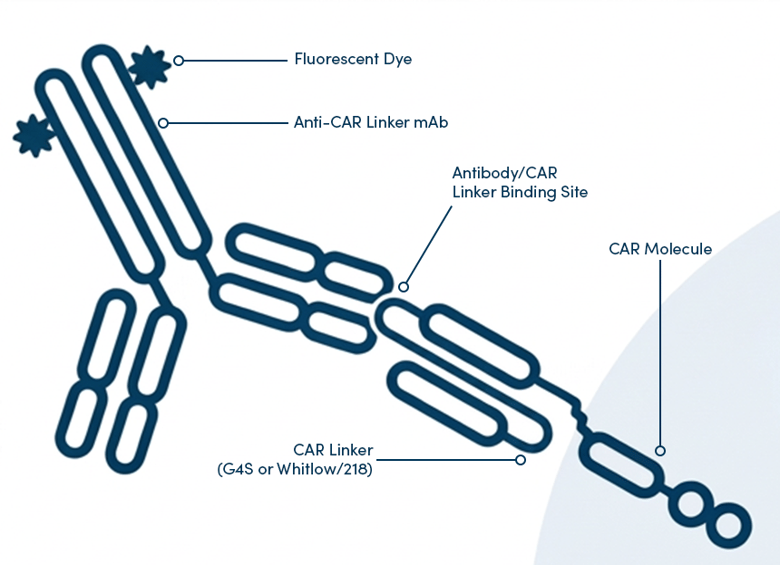
Fluorescent-labeled anti-CAR linker antibody bound to a CAR linker expressed by a T-cell.
G4S and Whitlow/218 linkers are not found in human proteins, but they are used in the majority of engineered scFv-based CAR constructs that target completely different antigens. That combination—synthetic, conserved, and structurally exposed—allows a new class of reagents to provide a clean signal for specific detection of CAR-positive cells.
Depending on the antibody selected and its validated applications, anti-linker antibodies support CAR-positive cell detection by flow cytometry, ELISA, or analysis of FFPE tissue, as demonstrated by CST5 along with external research collaborators. For tissue analysis, this specific detection enables researchers to identify engineered cells and examine their location alongside other cell populations.
For researchers, this linker-based approach could simplify characterization across preclinical studies, patient samples, and manufacturing development. Using appropriately validated antibodies against a shared linker could reduce the need to develop a new detection strategy each time the construct changes.
Inside the Tumor: What Are CAR-T Cells Actually Doing?
Blood measurements provide only part of the picture. With an antibody validated for FFPE tissue, researchers can identify CAR-positive cells in tissue sections and examine their location alongside tumor and immune-cell markers. This creates an opportunity to investigate how tissue context relates to CAR T-cell behavior, rather than relying on circulating cell counts alone.
These spatial relationships within the tumor microenvironment—particularly between cell types—may reveal factors that could impact therapeutic strategies. These insights not only clarify mechanisms of resistance but could also create a feedback loop for manufacturing. If certain phenotypes or spatial patterns correlate with better long‑term outcomes, clinical teams could start thinking about how to build or select for those properties earlier in the process.
Turning a Detection Tool into a Manufacturing Lever
The same specificity that enables anti-linker antibodies to detect engineered cells in complex tissue could also make them useful upstream in process development. With appropriate regulatory review, they could also enrich for CAR-positive cells in manufacturing. In today's CAR-T workflows, T-cell transduction success can vary substantially, yet all cells are carried forward into expansion and formulation. That means the final product contains a mix of CAR‑positive and CAR‑negative T-cells whose contributions to efficacy and toxicity are still being investigated.
“The more we learn about this, the more we'll be able to design manufacturing strategies that help us obtain the best response rates with the least amount of toxicity. And the fact that these different antibodies can be used across the spectrum, not only in preclinical development but also [with the required regulatory authorizations] in enrichment for manufacturing and finally in quantitative analysis…allows us to use the same platform, the same reagents to answer many of these questions off the shelf.”
— Leading CAR-T Physician-Scientist*
Enrichment could help normalize the CAR‑positive fraction across batches, making it easier to interpret dose–response relationships and to compare differences across individual patients. And it could give developers a way to explore what the non‑engineered “bystander” population is doing—whether it’s largely inert, subtly affecting toxicity, or playing a more active role than is currently appreciated.
Enrichment could be particularly valuable for products with low transduction efficiency, large payloads, or complex engineering requirements. In those contexts, enriching the CAR-positive fraction could offer a path to more consistent inputs.6,7

Linking Enrichment to Manufacturing Speed
Product consistency is not the only consideration; manufacturing time also matters. Even as in vivo cell therapy approaches advance, expert observations indicate that ex vivo manufacturing time and complexity are among the most conspicuous bottlenecks facing CAR‑T therapies. Long production runs can be especially challenging for patients with aggressive disease, who may not be able to wait for a custom product.
Cell enrichment gives process-development teams a way to investigate how the CAR-positive fraction affects product composition. Whether an added selection step improves consistency, reduces culture time, or changes the final cell population must be evaluated in the specific workflow.
“The challenge in the manufacturing space is really the time to deliver. How do we accelerate or minimize the time from T-cell collection to administration? This is important because not only do we feel like shorter manufacturing time is going to lead to higher quality products, but from a patient perspective, it also means that patients will be treated faster.”
— Leading CAR-T Physician-Scientist*
For scientists, enrichment and speed are closely linked. If anti‑linker antibodies were used to isolate CAR‑positive cells early in the workflow, manufacturers could focus expansion on the fraction that actually carries the therapeutic construct. That could open the possibility of reaching target CAR-positive doses faster, with less batch-to-batch variability in the transduced cell fraction. In such a context, enrichment wouldn’t be just a way to speed development—it could be a lever for reducing product heterogeneity.
The issue is no longer whether CAR-T manufacturing can scale. It is whether it can be done reproducibly, faster, and with enough control over product composition to support the next generation of CAR‑T therapies.
Closing the Loop Between Biology and Manufacturing
Understanding CAR T-cell behavior and improving process control are connected challenges. Reliable detection provides a way to study both: which cells are present, where they are located, and how product composition can be measured more consistently. The goal is not simply a faster workflow, but a clearer relationship between the product being made and the biology being studied.
Learn more about GMP-grade antibody conjugates for CAR-T manufacturing & QC
|
Important: All Cell Signaling Technology products are for Research Use Only (RUO), and not for use in diagnostic procedures. The GMP-grade reagents are not intended for diagnostic use or direct administration into humans or animals. See the full Limited Uses statement at cellsignal.com/gmp-limited-uses. *The physician-scientist interviewed for this blog requested that their name and affiliation not be published. In that person's quotations, use of the term "we" or "us" refers to the broader clinical community and does not reflect the positions of Cell Signaling Technology, Inc. |
SELECT REFERENCES
- Dan L, Kang-Zheng L. Optimizing viral transduction in immune cell therapy manufacturing: key process design considerations. J Transl Med. 2025;23(1):501. Published 2025 May 2. doi:10.1186/s12967-025-06524-0
- Wagner DL, Koehl U, Chmielewski M, Scheid C, Stripecke R. Review: Sustainable Clinical Development of CAR-T Cells - Switching From Viral Transduction Towards CRISPR-Cas Gene Editing. Front Immunol. 2022;13:865424. Published 2022 Jun 17. doi:10.3389/fimmu.2022.865424
- Gupta D, Shaz B. Surveying local CAR T-cell manufacturing processes to facilitate standardization and expand accessibility. J Transl Med. 2025;23(1):507. Published 2025 May 6. doi:10.1186/s12967-025-06400-x
- Neelapu SS, Locke FL, Bartlett NL, et al. Axicabtagene Ciloleucel CAR T-Cell Therapy in Refractory Large B-Cell Lymphoma. N Engl J Med. 2017;377(26):2531-2544. doi:10.1056/NEJMoa1707447
- Singh A, L'Heureux S, Sinapius R, et al. Generation and validation of anti-linker monoclonal antibodies for the detection of surface expressed scFv-based CARs. Poster presented at: AACR 2023; April, 2023; Orlando, FL.
- Tyagarajan S, Spencer T, Smith J. Optimizing CAR-T Cell Manufacturing Processes during Pivotal Clinical Trials. Mol Ther Methods Clin Dev. 2019;16:136-144. Published 2019 Nov 29. doi:10.1016/j.omtm.2019.11.018
- Abou-El-Enein M, Elsallab M, Feldman SA, et al. Scalable Manufacturing of CAR T cells for Cancer Immunotherapy. Blood Cancer Discov. 2021;2(5):408-422. doi:10.1158/2643-3230.BCD-21-0084
26-gmp-08150