


Despite having essential roles in immune defense and tissue repair, inflammasomes
contribute to the initiation and progression of many different diseases—especially
chronic conditions such as Alzheimer’s disease, Parkinson’s disease, and
rheumatoid arthritis. For this reason, inflammasome signaling pathways are being
widely investigated for therapeutic targeting. However, when developing
inflammasome therapeutics, it is crucial that any potential treatment does not
compromise the host’s ability to fight infection. This blog reviews some of the
inflammasome therapeutics in development and explores how CST products can be
used to characterize inflammasome signaling and assess the efficacy of inhibitors in
disease models.
Relevant Pathway |
Inflammasome Signaling |
|
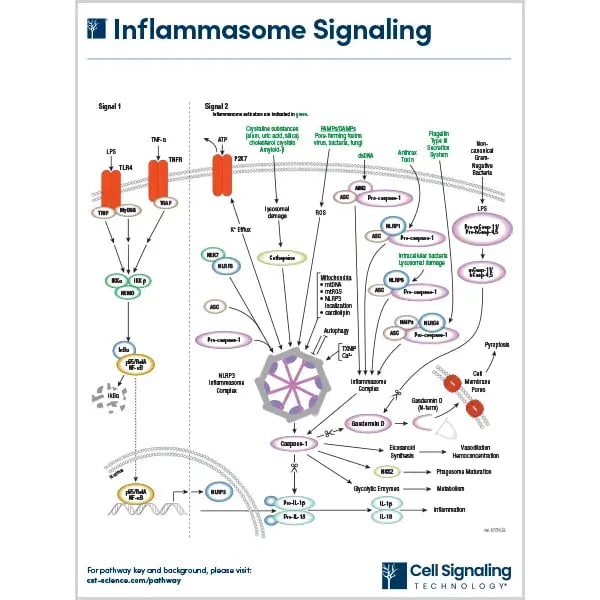
Drug development to treat dysregulated Download the Inflammasome Signaling pathway diagram to visualize key biomolecules and explore relevant CST products. |
Inflammasome Dysregulation and Disease
Aberrant inflammasome signaling has been linked to many different diseases,
including Alzheimer’s Disease (AD), Parkinson’s Disease (PD), Diabetes/Obesity,
Rheumatoid Arthritis (RA), and Systemic Lupus Erythematosus (SLE). Learn more
about how the inflammasome promotes chronic sterile inflammation in our earlier
blog, "How the Inflammasome Drives Disease: Tackling Aberrant Inflammasome Signaling", or read on to discover some of the inflammasome therapeutics in development.
Therapeutics Targeting the Inflammasome Pathway
Although several distinct inflammasome complexes have been identified, the NLRP3
complex—consisting of the NLRP3 pattern recognition receptor, the ASC adaptor
protein, pro-caspase-1, and the serine-threonine kinase NEK7—is the best-
characterized. As a result, the NLRP3 inflammasome has been extensively targeted
for therapeutic intervention, including using the following approaches:
NLRP3 Inhibitors
Specific inhibitors of NLRP3 are hypothesized to prevent inflammasome assembly and the subsequent release of proinflammatory cytokines. One of the best-known examples, Pfizer’s MCC950, selectively binds the NLRP3 NACHT domain to suppress its ATPase activity, disrupting inflammasome complex formation without inhibiting other inflammasome pathways. However, despite encouraging early results, the clinical development of MCC950 was halted during a phase 2 rheumatoid arthritis trial in 2001, primarily due to liver toxicity1.
Also targeting the NACHT domain, Dapansutrile (OLT1177) from Olatec Therapeutics, lacks the severe hepatotoxicity of MCC950 and is generally recognized as one of the safer NLRP3 inhibitors. It has advanced successfully through multiple phase 2 clinical trials, including those for acute gout flares and systolic heart failure. Yet, because the anti-inflammatory mechanism of Dapansutrile is somewhat pleiotropic, converging on STAT3 signaling suppression, its use could pose challenges for long-term immunomodulatory dynamics2.
Another NLRP3 inhibitor, VTX2735, developed by Ventyx Biosciences (an Eli Lilly company), is indicated for cryopyrin-associated periodic syndrome (CAPS), an autoinflammatory disease caused by gain-of-function NLRP3 mutations. In a phase 2 clinical trial, VTX2735 demonstrated an 85% reduction in symptom scores and decreased inflammatory biomarkers, providing a strong rationale for further development. Ventyx is also developing VTX3232, another NLRP3 inhibitor capable of central nervous system (CNS) penetration, and has recently completed phase 2a testing for treating Parkinson’s disease1.
NEK7 Degraders
An alternative strategy to disrupt the inflammasome complex involves using molecular glue chemistry to bridge NEK7 to an E3 ligase for targeted degradation. In a phase I trial for cardiovascular disease (CVD), Monte Rosa Therapeutics’ MRT-8102 significantly reduced C-reactive protein (CRP) levels in subjects with elevated CVD risk, paving the way for further clinical studies3.
IL-1β Inhibitors
Inhibiting proinflammatory signaling molecules is an established approach to treat inflammation. For example, canakinumab (ILARIS) is a fully human IgG1κ monoclonal antibody that targets residual cardiovascular inflammation by selectively neutralizing IL-1β downstream of the NLRP3 inflammasome. Approved to treat inflammatory diseases such as CAPS, familial Mediterranean fever (FMF), and tumor necrosis factor receptor-associated periodic syndrome (TRAPS), canakinumab is also in clinical trials for indications including cancer, rheumatic disease, and clonal cytopenia of undetermined significance4,5.
ASC Inhibitors
ASC governs the release of both IL-1β and IL-18 across major inflammasome sensors. As such, inhibiting ASC presents opportunities for pan-inflammasome intervention upstream of these pro-inflammatory cytokines. PS-1001 is an engineered VHH-Fc fusion protein, developed to treat the skin disease hidradenitis suppurativa (HS), which is driven by inflammasome dysregulation. Studies including in vivo assessment of PS-1001 in murine inflammation models (gout, psoriasis, and colitis) and ex vivo testing in the HS 3D-SeboSkin model, show that PS-1001 binds ASC with high affinity and reduces the release of IL-1β and IL-18, supporting entry into IND-enabling studies and first-in-human trials6,7.
Combination Therapies
In addition to targeting single molecules to disrupt inflammasome activity, drug combinations are under development, in which inflammasome inhibitors are used to dampen inflammation in proinflammatory conditions. For example, the pairing of ofirnoflast (HT-6184), a drug that breaks the physical interaction between NLRP3 and NEK7, with semaglutide (Wegovy), a GLP-1 receptor agonist, is being investigated to treat obesity-associated inflammatory anemia. Testing in a preclinical, diet-induced obese mouse model has shown promising results in restoring hematologic function8.
Conclusion
When developing inflammasome therapeutics, it is critical to understand how targeting a specific inflammasome signaling molecule affects both normal physiology and the disease. To trust your results, choosing rigorously validated antibodies from a reliable vendor is key. CST offers a broad selection of antibodies to help you unravel the complexity of inflammasome activation, structure, and function, all of which are meticulously tested in relevant applications according to the CST Hallmarks of Antibody Validation.
References
-
Cabral JE, Wu A, Zhou H, et al. Targeting the NLRP3 inflammasome for inflammatory disease therapy. Trends Pharmacol Sci. 2025;46(6):503-519.
-
Bai F, Wang D, Wu Y. Dapansutrile in multidisciplinary therapeutic applications: mechanisms and clinical perspectives. Front. Pharmacol. 2025;16:1731165.
-
Monte Rosa Therapeutics, Inc. Monte Rosa Therapeutics announces positive interim Phase 1 data of MRT-8102 demonstrating profound CRP reductions in elevated CVD-risk subjects. January 7, 2026. Accessed September 18, 2026. https://ir.monterosatx.com/news-releases/news-release-details/monte-rosa-therapeutics-announces-positive-interim-phase-1-data
-
Srivastava A, Dinesh D, Bhatia J, Arya DS. Immune–endothelial crosstalk in cardiovascular inflammation: Canakinumab at the intersection of mechanism and precision therapy. Biomedicine & Pharmacotherapy. 2026; Volume 198.
-
WhichTrial. Canakinumab. Accessed September 18, 2026. https://whichtrial.com/drug/canakinumab/
-
Padmanabhan N, Lim EK, Loh AY et al. 1046 Preclinical characterization of PS-1001, a novel pan-inflammasome inhibitor targeting ASC for the treatment of hidradenitis suppurativa. J Invest Dermatol. 2026;146(8) S181.
-
Padmanabhan N, Lim EK, Loh AYT, Kua L, Seet Q, Hossini AM, et al. Validating the "Bat Engine" for Target Discovery: PS-1001, a First-in-Class Pan-Inflammasome Inhibitor Inspired by Evolutionary Biology [poster]. Presented at: FOCiS 2026 Annual Meeting; June 9-12, 2026; San Francisco, CA. Published June 2026. Accessed September 18, 2026. https://paratussciences.com/wp-content/uploads/2026/06/Paratus-Sciences-FOCiS-2026-Poster-FINAL.pdf
-
Bearss B, Bearss J, Davis C et al. Targeting NLRP3 with ofirnoflast, alone or in combination with semaglutide, ameliorates inflammatory anemia associated with obesity-induced inflammation in rodent models. Blood. 2025;Vol 146, Issue Supplement 1.
26-ict-51700
26-ICT--51700